Tuesday, June 9, 2009

Lemons and Lemonade

Summertime's the right time to think about lemonade.  

You're familar with the old saw, "When life gives you lemons, make lemonade."  The saying resonates.  When something goes wrong, don't dwell on it: Make something positive out of the negative.

This is a particularly powerful concept in the world of Strategy Execution in the context of Reaching True Goals.  Reaching goals is a process.  During that process, it is almost inevitable that everything won't go smoothly.  Those are the "lemons."

The "lemonade"?  How you react to the lemons.  If you let the lemons throw you off, you get depressed, angry, discouraged.  The focus changes from reaching your goals to "fixing" the lemons.  That creates distractions.  The end result is frequently a shift from concentrating on reaching specific goals to correcting and avoiding future lemons.  And, somewhere along the line, the true goals get lost and forgotten.  

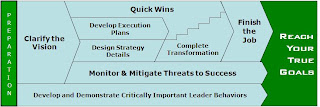
Making lemonade, on the other hand, means taking the lemons in stride.  Recognizing that they will occur, and reacting appropriately.  If you recall, one element of the RedZone Strategy Execution Framework is "Monitor and Mitigate Threats to Success."  That means watching out for and dealing with the lemons - the things that can get in the way and keep an organization from reaching its true goals.


A critical element of reaching goals is recognizing that lemons will and do show up along the way.  The key is to watch out for them, recognize them, and deal with them - and not let them derail the entire initiative.

Make Lemonade.  Reach Your True Goals.  Now that's a refreshing thought.


Wednesday, May 13, 2009

The Best of the Best....

This one's a little bit different.

With this post, I want to acknowledge and thank an incredible young woman.  And in the spirit of this blog, let me do it in the context of Reaching Your True Goals.

On Saturday, my daughter graduates from high school.  In the fall, she'll be attending the University of North Carolina at Chapel Hill (Go 'Heels!  Good thing she looks great in Carolina blue....).

Thirteen-plus years' ago, I watched a four year old little girl play in a room as her "application" to school.  This year, she graduates.  Great test scores.  Great grades.  Artist, photographer, athlete, service leader, peer leader, dedicated worker, music lover, elder in her church, friend, sister, daughter, granddaughter.  

(She was the youngest artist in Atlanta - perhaps anywhere - to be selected to paint a "Cow Parade" cow.  And she did it - even though, right after selection, she broke her arm playing kickball!  Talk about executing on your goals...)

Did everything always go her way?  Of course not.  But I learned plenty from her.  She never lost focus, no matter how discouraged she may have become.  She knew what was important, what her "true goals" were.  And she pursued them.  Not to the exclusion of having fun (goodness, no!), but to achieve her goals "on time, within budget, and of the right quality."

Yes, the best of the best.  Congratulations, Lacy.  And thanks.  You've taught your old man a lot over the last eighteen years.  I'm looking forward to learning much more from you in the years to come.


Wednesday, April 29, 2009

True Goals


I spend a lot of time talking to people about "reaching (their) true goals" - but what does that mean?  

There are 4 components to reaching true goals:

1) Accomplish the objective.  Do what you want to do.  Get it done.  Succeed.  Reach the finish line.  Anyway you want to define it, it's all about figuring out what you want to do and doing it...

Umm - hey, Gregg.  You said there were 4 parts to "reaching true goals."  But number 1 seems to sum it up pretty well.  What are the other pieces? 

Easy:

2) On time.
3) Within budget.
4) And with the right level of quality.


It's a constant struggle.  True goals, done right, is defined in the context of all four quadrants:  What you want to accomplish, by when, at what cost, and with what level of quality.

Accomplishing any subset of those - by my definition - means you haven't reached your true goals.

Let me belabor the point for a minute to, well, make a point:
  • I got what I wanted, but later than I needed.  True goals?  No.
  • I didn't quite get what I wanted.  TG? No.
  • Got it - but it cost more than planned.  Nope.
  • Well, I got it, on time, within budget - but it wasn't as good as it should have been.  Strike 4.
Too many organizations take the easy way out.  They don't fully identify what they're trying to accomplish up front, defined by all 4 attributes of the Challenge.  That way, it's easy to claim that you've succeeded... even when you really haven't.

The best result?  Know exactly what your True Goals are before you start - defined as reaching the desired result, on time, within budget, and with the right level of quality - and then go get them.


Friday, April 10, 2009

Driving the Car, Changing its Tires...

Here's the challenge:  The division is having a great year, even with economic challenges all around.  Revenue is up; expenses are down; margin is improving.  It's hitting its numbers and, for the most part, hitting on all cylinders.  Yet, it has been tasked by corporate headquarters to make some aggressive changes, including cutting expenses and (perhaps) rethinking its entire business model.  How, if you're division management, do you: 

  1. Motivate the team
  2. Convince the team that it's the right thing to do, and
  3. Make it happen, especially in the midst of "good times"?

Fortunately, RedZone has a client that sets a great example.  Here are some suggestions, in brief, based on experience:


1)  Consistent and clear messaging.  Management has made clear its opinion that the best time to make challenging changes is when times are good, when it has control over the situation and when it is not in "crisis" mode.  Management is right.  Making changes when times are good may be difficult from a motivation standpoint, but the absolute best from a strategic perspective.


2) Challenge the team.  A company that is performing well is doing so for a reason.  In most cases, it's because there is a talented and committed management team driving performance.  So how does one get a well-performing team to change and do even better? Challenge them. Challenge them to use their imagination and energy, to think differently about the business. Challenge them to identify what's wrong with the current business (trust me, they know!), and to identify how to fix it (they know that, too).  And listen.  There are details about the business that only those on the front-lines know. Management perspective is important, but the details from the field can make the difference between success and failure. And then align rewards with success. Make sure the team achieves personal benefit from making difficult changes work.


3) Don't take "no" for an answer. Sometimes, when things are going well, there is great hesitancy to make big changes aggressively.  That's the time when management has to step up and say, "Sorry, that's not good enough."  Management makes the goals clear, and makes it clear that the goals are non-negotiable.  And then, it keeps up the gentle pressure.  Yes, it says, we know this isn't easy.  Yes, it says, we know this is a higher level than we've ever reacher.  Yes, it says, we know this will require some big changes to the way we operate today. And yes, it says, we're willing to make those changes.  So, it says, think big, think broad, think different.  You come up with the right answer.  We'll (all) come up with how to make it happen. 


What’s the Problem? 


That’s what our client does, and does well. So, why is RedZone involved? This well-run organization, like so many others, struggles with execution. Not everyday, continual improvement, keep-the-business-running execution. No, its struggle is in strategy execution – the challenge of making big changes while still keeping the operation humming. 


An analogy you may have heard is that of “driving a car while changing its tires." In other words, the organization is focused (as it should be) on keeping the day-to-day running smoothly. But it’s also tasked, at the exact same time, with making significant changes to how it does business. 


That’s where RedZone comes in. Our focus is Strategy Execution – helping organizations successfully execute significant strategic initiatives. And part of our advice – always – is to isolate the team working on the significant change from the daily execution of the business. You know the reason – our client does, too. The challenge is making it happen.

Running the day-to-day business means constant adjustments, monitoring, fire-fighting. Much of that is unpredictable and urgent in nature: When an issue occurs, it must be handled right now. That means other activities get put to the side. And if one of those other activities is working on a strategic initiative, it gets put to the side, too.

Focused, Dedicated, Separated

One key to successful Strategy Execution is to segment the resources: Making sure those involved in “driving the car” aren’t the same as those trying to “change the tires.” Think of it this way: Running the day-to-day business is pretty much a straight, fast line – slight adjustments, tweaks along the way, but, for the most part, straight forward. A strategic change is not just a little shift. It’s a sharp curve in the road, a change to take the company in a different direction. The team responsible for driving the company forward as fast and hard as possible is rarely the same team that does a good job taking the sharp curve. The focus is different, the skills needed are different, the entire process is different. So make the team different. Let one group drive the company straight-line forward while another team sets the company up to take the curve. Take it. The company is on a straight-away again (at least, for a while!), and the operational team is now perfectly capable of taking over the wheel.

But, the argument always goes, we don’t have the resources, time or budget to do that. And our response, always, is yes, you do. If you’re staffing strategic projects right now with people responsible for running the day to day operation, you have got the people and budget. It just takes hard work to find it. Here’s why: By staffing a strategic initiative with operational leaders, you’re making an assumption that each person will spend, let’s say, 80% of their time (4 days a week) running the business and 20% (one day each week) on the strategic project. That means you have budgeted 20% x the number of people involved on getting the project done. But it never quite happens as desired or planned.

So – and here’s the really tough part – separate the people. You’ll need to move around responsibilities, perhaps make some people stretch, but figure out how to take the 20% of 5 people’s time and turn that into 1 person at 100%. Use the others as resources, to answer questions, participate in review and design sessions, provide guidance and support. But task someone else to get the work done as their full-time job. The end result is that strategic projects will get done on time, within budget, and with goals fully met. 

A simplification? Yes, but not by much. RedZone’s experience proves assigning a focused and dedicated team to the execution of strategic initiatives has a huge impact on their ultimate success. 

It’s always a pleasure to work with well-managed clients. But it also creates a unique set of problems. “We’re doing a great job of running the business. What can you teach us?” Well, in terms of day-to-day running the business, nothing much. But RedZone’s expertise is not daily operations – its expertise is in the unique and not-as-common processes needed to implement strategic change. Strategy Execution requires a different set of skills, tools, and management techniques. It’s in the successful execution of strategic initiatives where RedZone adds value – even to the best-managed of companies.
Saturday, March 21, 2009

Voltaire Had It Right

The shoemaker's child syndrome has struck again.  You know that story, right? The shoemaker's children are those who walk around town without any shoes. That's me. I sit down to write - and discover that I'm writing about a topic I know all too well.

It has been a while since I've been back here to blog.  As I sat down to write, I recognized that I have been a victim of the exact issues I've chosen to write about - Perfectionism and Making Choices.

Over the last several weeks, I have struggled to come up with the perfect blog topic.  I generated several ideas and debated which was the best.  As a result, I have not written anything. Instead of getting something good done, I sacrificed making any progress at all to the alter of Perfectionism and Making a Choice.  My guess is you've done the same.

Right now, RedZone is working with a client that is trying to do it all right. And that's a big part of their problem. There are two major challenges imbedded within the concept of "Doing It All Right."
  1. Doing it All, and
  2. Doing it Right
"I Can't Make a Choice - So I Won't Do Anything"

When you were younger, was there ever a day when there were so many things you wanted to do, you'd end up not doing any of them?   Have you ever sat in front of a "To Do" list, feeling overwhelmed by all the items on it - so you just sat and looked at it?  

You've met the enemy:  "Doing it All."

We know that we can't get it all done, all at once.  We don't have the resources, the time, the ability.  But somehow, we end up wanting it all anyway.  So we try to figure out what to do to get it all done.  We build a plan.   We see we will need to make choices, do things one at a time, in a sequence that makes sense and builds one activity on the last.  It will take time, effort, investment, and little steps leading to our final goals.  We know all this!  Yet we keep looking for the "magic wand," the way to get it all, all at once. 

The smart ones among us shrug our shoulders and say "Let's get started."  And they do.  One task at a time, checking it off the list.  Things start getting done.  You experience little successes. You get closer to finishing the list, and reaching your goal.

Sometimes, the tasks you choose to do aren't the most important, but they're quick, give you a sense of accomplishment and success.  On occasion, the choice is because of prerequisites - you don't really want to do this one (say, priming a wall) but you have to because it is needed to complete the more important activity (painting the wall).  Frequently, things fall off the list.  Others get added.  The list never seems to end - but things are getting done.  And you continue to get closer and closer to your goals.

RedZone is all about getting things done.  "There's a big difference," we say, "between deciding to succeed - and doing it."  Our focus is on "doing it" - getting it done.  But we don't get the chance to get anything done if we don't "decide" first - we have to choose what to do, then do it.

"The Perfect is the Enemy of the Good"

The original quote in French is "Le mieux est l'ennemi du bien.", from Voltaire's Dictionnaire Philosophique (1764) Literally translated as "The best is the enemy of good.", but more often cited as "The perfect is the enemy of the good."

Pursuing the "best" solution may end up doing less actual good than accepting a solution that, while not perfect, is effective.  General George Patton stated a current version of the same idea: "A good plan implemented today is better than a perfect plan implemented tomorrow."

Our client wants a perfect solution.  It wants one that is painless, riskless, costless, easy to implement, agreeable to all, and guaranteed to succeed.  As you might imagine, it's pretty tough to come up with a solution that fits these criteria.   Alternatives get discussed, but none are perfect.  And management's concerns about the solutions proposed are reasonable:  There is risk.  Some people won't like the solution.  It will be difficult to implement and may not succeed.  And so, in pursuit of the perfect solution, nothing gets done. 

This is a problem that has been recognized through the ages, not just by Voltaire and George Patton:
  • A man would do nothing, if he waited until he could do it so well that no one would find fault with what he has done.--John Henry Cardinal Newman

  • A person determined never to be wrong won't likely accomplish much.--Ken Wisdom

  • Better to do something imperfectly than to do nothing flawlessly.--Robert Schuller

  • Everything that grows holds in perfection but a moment.---William Shakespeare

  • Freedom is not worth having if it does not connote freedom to err. It passes my comprehension how human beings, be they ever so experienced and able, can delight in depriving other human beings of that precious right.--Ghandi

  • Have no fear of perfection. You'll never reach it.---Salvador Dali

  • In order to go on living one must try to escape the death involved in perfectionism.--Hannah Arendt (Rachel Varnhagen)

  • It is reasonable to have perfection in our eye that we may always advance toward it, though we know it can never be reached.--Samuel Johnson

Perfectionism ("Doing it Right") and Making Choices ("Doing it All") are enemies of getting worthwhile things done.  Would it be nice to be perfect, and get everything done at once?  Of course! But that's not real, resonable, or a strategy on which to succeed.    We need to make the best choices we can, given the information we have, and do.  We have to do the best job we can, given the time, resources, capabilities we have, and get things done.  

We'll discover new requirements along the way and add them to the list.  We'll work hard and have to make more choices.  But every step takes us closer and closer to our true goals.

Getting a lot done very well is much better than not getting anything done at all.  We won't be perfect.  We won't get it all done.  But we will get a lot done very, very well.  And we will succeed.

Wednesday, February 18, 2009

Strategy Execution = Google Maps. What?

Three key concepts in successful strategy execution are "Line of Sight," "Milestones," and "Leading Indicators."  And one of the best metaphors for explaining what they are and how they contribute to reaching goals is Google Maps.

Going someplace new, there are people who will just jump in the car and start driving.  "I'll find it."  And often they do - but after taking wrong turns, a longer time, and probably spending more money than necessary.

A New Destination

When does someone use Google Maps? When going somewhere new, somwhere they haven't been before (or, at least, somewhere they haven't been recently).    Using Google Maps is pretty simple - you put in your starting point and your destination, and Google provides the directions. Google even offers an estimate of how long it will take to get there.

The secret, of course, is in the directions.   You wouldn't use Google Maps if you knew exactly how to get where you want to go.  And what are directions?  Well, directions are a collection of line of sight, milestones, and leading indicators.

When you start a journey, you can't "see" your destination.  All you can do is follow directions, using milestones, leading indicators, and line of sight, and eventually you reach your goal.

Start from point A.  Travel north (line of sight) 3 miles (your odomoter at 2.8 miles is a leading indicator - you're getting close to a milestone).  Turn left onto Clairemont (milestone). Go east on I-85 27 miles (using the signposts along the road and your odomoter provides leading indicators and line of sight - you're on the right road, going in the right direction, and getting closer to the next milestone).  Take exit 44B (milestone), go straight 3 miles (line of sight).  You are at your destination.

When you started on the journey, you knew what you wanted your final destination to be - but you couldn't just "get there."  (Don't we all want the ability to "Beam me up, Scotty," and just get to your goal without having to take the time and do the work to get there?)  No, you followed a path that you charted out in advance.  And you knew, if you followed the path carefully, you would eventually reach your desired destination.

Sometimes, you take a wrong turn and have to adjust to get back in the right direction. Sometimes it turns out the plan isn't right (have you ever read the fine print on the bottom of a Google-recommended route?) and you need to make changes along the way.  Sometimes the plan has unexpected delays - but you know, if you just get through them, you'll still get to where you want to be.  Perhaps delayed, perhaps it will cost more than you had originally planned - but you will get there.

And sometimes, while on your trip, you decide that where you wanted to go originally has changed.  So, the plan has to change - because you're now headed for a new destination.

Line of Sight, Milestones, Leading Indicators

Yes, taking a trip is a lot like undertaking a new initiative.  You know where you are at the start. You know where you want to be at the end.  And you've got to figure out how to get there.

Just like a trip, successfully reaching goals requires a map.  It's not always easy to navigate from here to there.  You need milestones, line of sight, and leading indicators.  You need the signposts that tell you you're going in the right direction; you need the indicators that tell you it's time to turn.  Sometimes you need to review the map, and decide that a different route is needed.

Frequently, we know the goal - but we can't easily or quickly get there.  We certainly can't "see" the final destination from the starting point.  So build your map.  Decide your route.  Identify the milestones and indicators that will guide you along the way, that will help assure you that you're going in the right direction and on the right path - or those that will warn you if you're not. "Google Map" your strategic initiative.  And you will greatly increase the odds of reaching your goal.


Monday, February 2, 2009

Strategy Execution - in verse!

Limericks and haiku. Who knew?

There once was a leader inept
Who laughed while his teammates all wept
Their goals not aligned
He missed all the signs
And the team? They all left while he slept.

Follow the framework
Forget not nor ignore risk
And success will come.

It is easier
To plan what you want to do
than to get it done.

Mitigation of risk is the goal
When you survey and measure each role
Try to note all the schemes
That could fracture your team 
Or your efforts will slide down the hole.

If it's different results that you need
You must plant the behavioral seed
With clear reinforcement 
And gentle endorsement
There is no doubt your plans will succeed.

He got to the red zone so fast
The rest of the team couldn't last
He forgot what he learned
About "leaders get burned"
When the team that he's leading has crashed!

A goal focused team
Concentrates every action
On the end result.

RedZone Consulting
is the perfect length for the
start of a haiku.

And also for it's end.